Composing and Recomposing the Venetian Lagoon
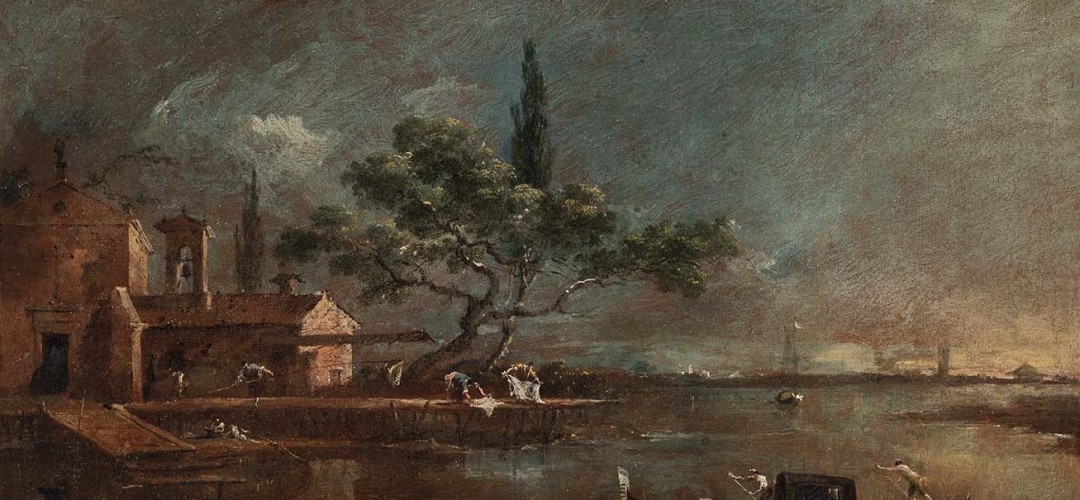
We share the contribution by Jane da Mosto, We are here Venice ETS’s Executive Director and Emma Rose Cyr, Social Anthropology Researcher from the Stockholm University, for the new Ecocritical Guide to the Gallerie dell’Accademia of Venice, published by Wetlands and edited by Camilla Pietrabissa and Michele Nicolaci. Their article “Composing and Recomposing the Venetian Lagoon,” examines Francesco Guardi’s painting "Isola dell’Anconeta", exploring the transformation of the Porto Marghera landscape through the years, and you can read the full original version below:
Before you, is an island that no longer exists. Francesco Guardi’s Isola dell’Anconeta depicts a marginal place whose erasure is not just a matter of wind and sea, but of superposition: today, the solid ground of the Porto Marghera industrial complex covers the same space that was once islands, barene, and water. The painting is more than a reminder of an island that has been forgotten under layers of concrete and history. It provides an invitation to address salt marsh (barena) restoration and painting together as two practices of interpretation, in the shadow of the commercial, industrial, and infrastructural processes that have transformed Venice and the lagoon.
barene are sediments, tides and vegetation plus a myriad of other life forms connected by dynamics on different timescales from seconds to geological eras
A view of the landscape is always a view from somewhere, as Donna Haraway has explained, so let Isola dell’Anconeta guide you through a series of movements to trace how a lagoon is composed, on canvas or in the mud, across situated times and places. Oil paints are pigments suspended in oil; barene are sediments, tides and vegetation plus a myriad of other life forms connected by dynamics on different timescales from seconds to geological eras. In both cases, composition is a polyphonic more-than-human choreography of representation, of interacting with – or just witnessing - what appears in the frame and what disappears into a hazy background.
Step inside the painting, and look around. You are in the 1760s, at the central edge of the Venetian Lagoon. Perhaps you are on a gondola, like the one that drifts across the foreground, cutting through the still dark waters. The sky, too, is dark, but the light on the horizon suggests a setting sun. In the twilight, the island in front of you, Anconeta, hosts a church, the same color as the mud and the stilted pier that juts out into the lagoon, protected by cypress and a weathered pine. On the island, fishermen work, checking nets in the shadows of the church while two figures, highlighted by the setting sun, lay out cloths. There is a tower far in the background, and a small hut a bit closer, both hazy and fading into the sky. It is hard to tell where the water ends and the muddy island begins.
Row in further now, past the barena on the right, around the faint hut on another strip of higher land, into the background that disappears into the hazy sky. You’ve slipped out of Guardi’s frame now, but keep rowing through the canal flanked by reeds, past other boats carrying goods—livestock, wine, stone—from the hinterlands and into Venice. Notice that the water here is brackish, a testament to the feats of engineering undertaken by the Serenissima Republic of Venice more than a century before the painting to re-route the Brenta river. You are in an artery of the Serenissima’s trade and military power, in a canal that flows all the way from Marghera, the village that has sprung up as a bustling commercial and military stopover between Venice and its inland territory. You finally reach the tower from the background, one of the many military fortifications around the lagoon, probably the Torre di Marghera on the island of San Giuliano. Rather than illustrating the military might of the Serenissima, however, in this painting the hazy tower contributes to a sense of peripheral isolation. From here, it is a straight shot along the San Secondo canal to reach the city of Venice—but first, you would have to pass through the check-point or palada, the wooden posts that block the canal to control the movement of people and goods.
Now come back out of the painting and stand again in front of the canvas. Look at Anconeta with a sense of its place along an infrastructural corridor in what was already a profoundly anthropogenic lagoon, though these elements fade into the haze of Guardi’s painting, a veduta—or view painting—of an idyllic lagoon situation. As a vedutista, Guardi followed Canaletto in painting scenes primarily for northern Europeans on the Grand Tour who wanted portable Venetian memories of their travels to bring home, thereby circulating a curated imaginary of Venice. Each veduta is a selection, one possible view amongst many, and more of a dialogue with reality than a direct reproduction: distortion, emphasis, and perspective allowed a subjective representation of a particular image of Venice, designed for circulation and consumption.
a strip of barena, and quotidian lagoon life, with the infrastructural lagoon and decadent monumentality receding into the haze.
While Canaletto’s rational, precise, and detail-oriented depictions of an ‘ideal’ Venice produced a sense of splendour and Republican power, Guardi emphasized atmosphere and mood over detail, utilizing fleeting and open brush strokes that capture transience in light and movement rather than the permanence of a mighty Serenissima. Here, this effect and the chosen composition produce a pastoral image: a peripheral and unpretentious island church, a strip of barena, and quotidian lagoon life, with the infrastructural lagoon and decadent monumentality receding into the haze.
Try to go looking for Anconeta now. Take the train across Ponte della Libertà, or maybe a bus. Compare some old documents to Google Maps and find yourself not on a pastoral island but in the heart of Porto Marghera, roughly on Via dei Petroli, close to the Eni refinery. Perhaps you have seen the nearby factories before from across the water, maybe at sunset when the smokestacks and iconic arched pipeline bridge rise like a burning cityscape out of the lagoon. If the Anconeta of the 1760s told a story of a lived-in yet infrastructural lagoon in the twilight of the Republic of Venice, a place where for centuries the ‘natural’ had been allowed to integrate itself with the human (or vice versa), contemporary Porto Marghera represents a paradigm shift in which human development decisively imposes itself on the natural dynamics of the lagoon system.
The water has been pushed away, and the barena that we saw within the frame has long since disappeared, together with more than 70% of its kin.
As you stroll through the industrial grid of concrete and fences, notice how solid the ground beneath your feet seems, considering that just over a century ago this was a mosaic of barene, shallows, and canals. The water has been pushed away, and the barena that we saw within the frame has long since disappeared, together with more than 70% of its kin. The construction of the industrial zone and its accompanying excavations to accommodate enormous ships— oil tankers, container ships and passenger vessels, veritable giants of the lagoon—have contributed to the destruction of vast areas of salt marsh, while the wave motion of those same giants exacerbates the ongoing erosion of the Lagoon and threatens the survival of remaining wetlands. And, to return to that stormy day and salty water around Anconeta, the interventions already carried out by the Serenissima mean that there is minimal importation of fresh sediment: the metabolism of the lagoon had already changed. Tracing Anconeta through time here, to the Porto Marghera of the present, reveals the continuation and interruptions on the edge of an infrastructural lagoon all the way from the Serenissima to the further reaches of the Veneto Region.
just as the lagoon can generate a variety of painterly representations, so too can it generate different mixtures of habitats, each with its own response to biodiversity loss and climate change.
In one final movement, follow the sediment displaced by Anconeta’s afterlife as Porto Marghera. The industrial shipping canal which feeds the engine of the industrial port depends on regular dredging to maintain the depth required by huge ships. When possible, the sediment that is dredged is redeployed in other parts of the lagoon to nourish reconstructed wetlands – surrogate barene. The NGO We are Here Venice works to regenerate the ecological functionality of these reconstructions, which involves designing interventions whereby this sediment is a component of nature restoration just as the pigments of a painting. Restoration in this case is not an attempt to recreate a previous ‘natural’ state; as our expedition to the 1760s revealed, the lagoon has long been an energetic mix that challenges nature-culture binaries. In that tangle, restoration becomes a process of articulated reasoning and conscious selection, of composing robust multispecies futures: just as the lagoon can generate a variety of painterly representations, so too can it generate different mixtures of habitats, each with its own response to biodiversity loss and climate change.
Come to a barena-in-progress and see for yourself. Be careful not to crush the budding grasses as you walk, boots squelching in the waterlogged sediment. Try to keep your balance as the mud pulls you in. As you come to a drier area, sit down on the sandy ground, and look around you – there are extensive barren areas that are vulnerable to erosion by the tides and waves. The restoration team must consider this condition as well as the multiplicity of alternatives including promoting the growth of denser vegetation that would sequester more carbon (a key “ecosystem service” for climate change mitigation of reconstructed wetlands), or leaving this space open for the arrival of ground-nesting coastal birds whose habitats have been destroyed by sea-level rise.
Restoration in the lagoon is never just the application of a neutral ecological science, but an active and situated design of lagoon futures
These alternative lagoonscapes mirror the diversity of lagoon viewpoints and depictions. In this sense, restoration is not so different from painting. It is a practice of composition under constraint and in the company of more-than-human others, an aesthetic-ethical labour of deciding what belongs in the lagoon-city. Restoration in the lagoon is never just the application of a neutral ecological science, but an active and situated design of lagoon futures: each new barena composes a version of the lagoon, selected from all the others that could have been.
Cover image: Francesco Guardi (1712 – 1793), Isola dell’Anconeta, oil, 32 x 51 cm, inv. 706, Room 8. Gallerie dell’Accademia, Venice.
Bibliography
Bettagno, Alessandro. Francesco Guardi: vedute, capricci, feste. Electa, 1993.
D’Alpaos, Luigi. L’evoluzione Morfologica Della Laguna Di Venezia Attraverso La Lettura Di Alcune Mappe Storiche e Delle Sue Carte Idrografiche. Comune di Venezia, 2010.
Foffano, Redi, and Dario Lugato. Da Marghera a Forte Marghera. Edizioni Multigraf, 1988.
Haraway, Donna. “Situated Knowledges: The Science Question in Feminism and the Privilege of Partial Perspective.” Feminist Studies 14, no. 3 (1988): 575–99.
Martineau, Jane, and Andrew Robison. The Glory of Venice: Art in the Eighteenth Century. Yale University Press, 1994.
Morassi, Antonio. Guardi: Antonio e Francesco Guardi. 2 vols. Alfieri, 1973.
Packer, Lelia, and Charles Beddington. Canaletto and Guardi: Views of Venice at the Wallace Collection. Scala, 2025.
◾